
The Fall of the Roman Empire
The story of the Fall of the Roman Empire is one of history’s most captivating narratives. Once the most powerful and advanced civilization on Earth, Rome’s decline was a slow and complex process that took centuries to unfold. Historians have long debated whether Rome truly “fell” or simply transformed, but there’s no denying that the Western Roman Empire’s collapse in 476 CE marked a major turning point in world history.
Political Instability and Corruption
One of the main reasons for the Fall of the Roman Empire was political instability. The empire suffered from constant power struggles, with emperors being overthrown, assassinated, or replaced in quick succession. This chaos weakened the central authority and made it difficult to maintain order. Corruption became rampant as senators and officials prioritized their personal wealth and power over the welfare of the state. The once-disciplined Roman government turned into a web of intrigue and self-interest, leading to widespread discontent among citizens and soldiers alike.
 Economic Decline and Financial Crisis
Economic troubles were another major factor behind Rome’s downfall. The empire relied heavily on slave labor, which stifled innovation and reduced productivity. As expansion slowed, Rome’s supply of new slaves and resources dwindled, leading to economic stagnation. To fund its massive military and bureaucratic system, the government imposed heavy taxes that crippled farmers and merchants. Inflation spiraled out of control as emperors debased the currency to pay their debts. This financial strain eroded public confidence and left the empire vulnerable to external threats.
Military Weakness and External Invasions
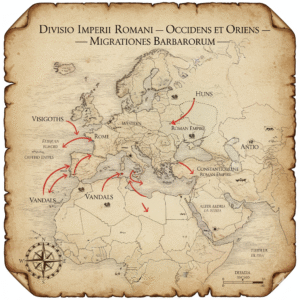
Rome’s military, once the pride of the ancient world, began to decline as well. The legions that once conquered vast territories became overstretched, underpaid, and poorly disciplined. To fill the ranks, Rome increasingly relied on foreign mercenaries who had little loyalty to the empire. As a result, defense weakened just as waves of barbarian invasions began. The Visigoths, Vandals, Huns, and other tribes repeatedly attacked Roman territories. In 410 CE, the Visigoths famously sacked the city of Rome, shocking the world and symbolizing the empire’s fading glory.
Cultural and Moral Decay
Beyond politics and war, Rome also faced moral and cultural decline. The early Roman values of discipline, duty, and sacrifice gave way to luxury and excess. Citizens became more interested in entertainment, lavish feasts, and personal pleasure than in civic responsibility. Historians like Edward Gibbon argued that this moral decay sapped Rome’s vitality and sense of purpose, leaving it unprepared to face the growing challenges from within and without.
The Division of the Empire
Another critical turning point came when Emperor Diocletian decided to divide the empire into Eastern and Western halves in 285 CE to make administration easier. While this division temporarily stabilized the empire, it also created long-term problems. The Eastern Roman Empire, based in Constantinople, became wealthier and more secure, while the Western Empire grew weaker and more exposed to attacks. Over time, the two halves drifted apart politically, economically, and culturally, making it harder to coordinate defenses and maintain unity.
The Final Collapse
By the fifth century, the Western Roman Empire was in ruins. The final blow came in 476 CE when the Germanic leader Odoacer deposed the last emperor, Romulus Augustulus. Although the Eastern Roman Empire, known as the Byzantine Empire, continued to thrive for nearly another thousand years, the fall of the West marked the end of ancient Rome’s dominance. Europe entered what historians now call the Middle Ages, a time of fragmentation and transformation.
The Legacy of Rome
Despite its fall, the Roman Empire’s legacy endures in countless ways. Roman law, architecture, engineering, and language shaped the foundation of modern Europe. The Roman Catholic Church preserved Latin learning and many aspects of Roman culture throughout the medieval period. Modern concepts of government, citizenship, and infrastructure still trace their roots back to ancient Rome. Even today, the ruins of Roman cities, roads, and monuments remind us of the empire’s grandeur and enduring influence.
Conclusion
The Fall of the Roman Empire was not a single event but a gradual process driven by political corruption, economic weakness, military decline, and social decay. Its story serves as a powerful reminder of how even the greatest civilizations can crumble from within. Yet, Rome’s spirit never truly disappeared. Its laws, language, and legacy continue to shape the modern world, proving that while empires may fall, their ideas can live forever.